New York State law currently prohibits parking within 20 feet of an intersection with a crosswalk. However, New York City has long exempted itself from this critical regulation.
Traditionally, vehicles were lower to the ground with longer hoods, allowing drivers to maintain better visibility even when others parked their cars at the intersection. But in recent years, the rise of taller, snub-nosed SUVs has dramatically reduced visibility at intersections. This often forces drivers to creep far into the crosswalk—sometimes beyond it—before safely ascertaining whether the intersection is clear. The frequency of crashes at intersections has risen sharply, highlighting the need for prohibiting parking at intersections.
The city of Hoboken, N.J., has set an example by “daylighting” every intersection with additional treatments to keep it clear, resulting in an impressive record of zero traffic fatalities for over seven years. According to Fox News,
“For seven years now, the city of nearly 60,000 people has reported resounding success: Not a single automobile occupant, bicyclist or pedestrian has died in a traffic crash since January 2017, elevating Hoboken as a national model for roadway safety.”
In comparison, Bayside has about 50,754 people and unfortunately has had many pedestrian deaths over the same period including. Just in 2024 so far we know of two pedestrians killed:
- Elisa Maria Bellere killed in crosswalk while jogging in Bayside
- Curtis Blocker struck, killed by vehicle on Cross Island Expressway
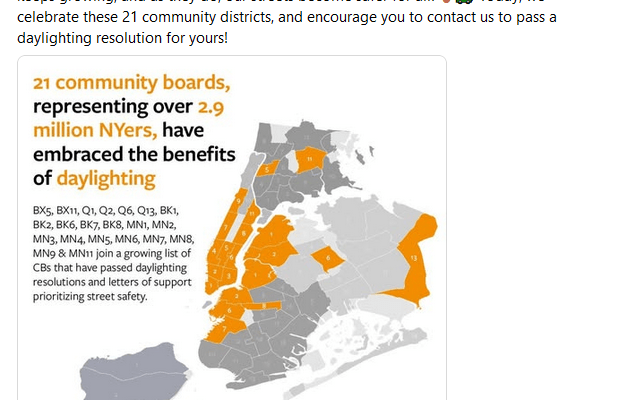
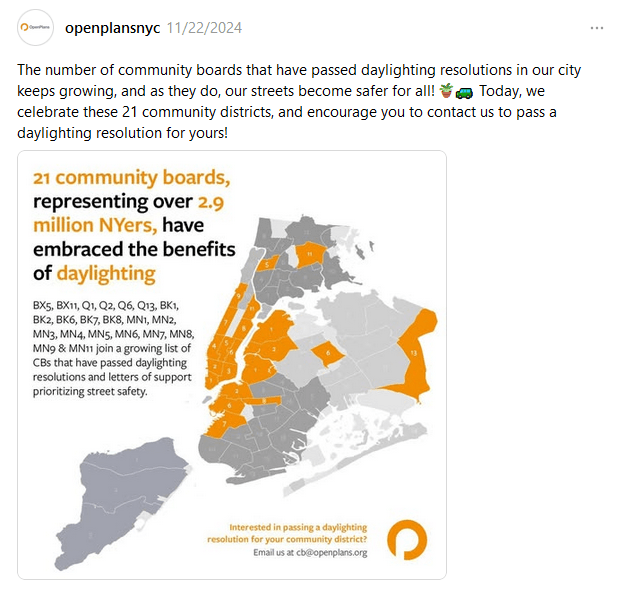
Following this lead, Community Board 13, covering a significant portion of Eastern Queens, has passed a resolution advocating for universal daylighting of intersections. Councilwoman Julie Won has introduced Bill #1138 to align NYC law with state law, enhancing safety for both drivers and pedestrians. We hope other Community Boards and local Politicians will do that right thing and make things a bit safer for pedestrians and drivers.
You can make a difference right now by signing a petition for universal day-lighting across New York City. It’s gaining momentum, but there are still major obstacles holding back this proven life-saving technology.
 Eastern Queens Greenway