
In New York City’s sprawling urban landscape, where concrete and steel vie for supremacy, the subtle charm of pedestrian pathways and bike lanes often goes unnoticed. Yet these arteries of non-motorized travel promise a future brimming with sustainability, safety, and a touch of serenity amidst the urban cacophony. With last year’s resounding success in securing a new grant, now is the opportune moment to seize the momentum and secure a second round of funding while the coffers are still brimming.
Historical Information
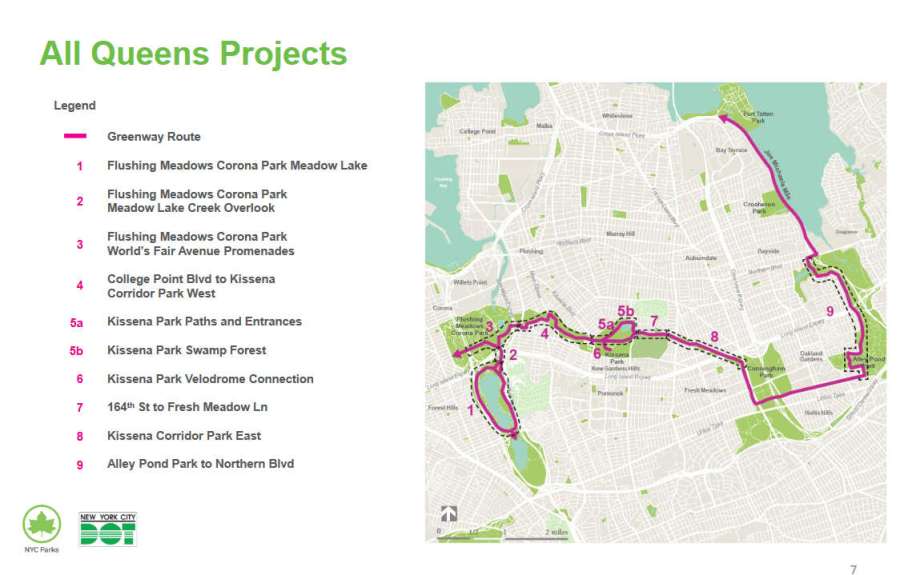
New York City Parks’ Commissioner Robert Moses envisioned a trail running from Flushing Meadows Corona Park through the Emerald Ribbon of Kissena Corridor Park and looping around Little Neck Bay as one of his legacy projects. Unfortunately, only sections of this trail were built. We started this project over 10 years ago and have already secured protected bike lanes along the edge of Alley Pond Park linking the Motor Parkway Trail and Joe Michaels’ Mile, and we have secured over $43.4 million to fill in the gaps in the greenway between Main Street and the Motor Parkway.
The Opportunities
In August of 2022, Mayor Eric Adams announced that New York City had received a $7.25 million federal RAISE grant to plan a significant expansion of the greenway network, focusing on underserved, lower-income communities. The grant builds on nearly $50 million investment in greenway projects in Central Queens and Southwest Brooklyn, aiming to create more sustainable, accessible, and equitable citywide infrastructure. Many of the requested projects were funded, but there are still major gaps that could be funded in future grants.

There are upcoming funding opportunities that the city should apply for to study improvements in greenways and trails throughout the city. However, we would like to highlight some projects in Eastern Queens we feel are deserving of additional funding, arranged in order of importance:
Botanical Gardens
In 2002, the Queens Botanical Garden presented a master plan that included a vision for a bike path bridge, which would have served as a western entrance to the gardens, an urban greenway—a beautiful way to provide access to the garden. In subsequent versions of the plan, the bike path bridge was removed.
Currently the old bridge over College Point Boulevard stands, leading to an locked gate to the Botanical Gardens and stairs making it unusable for cyclists, wheelchair users, and many other users.
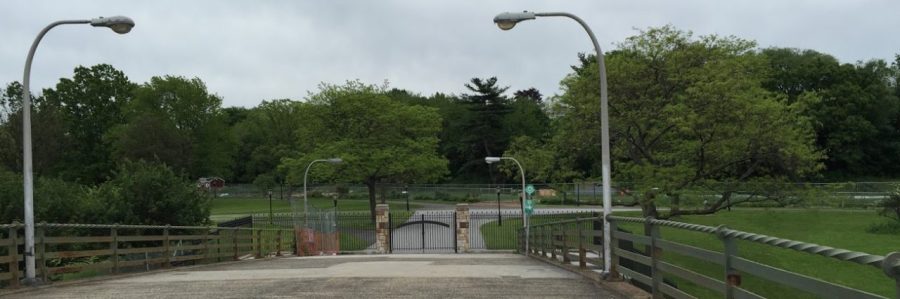
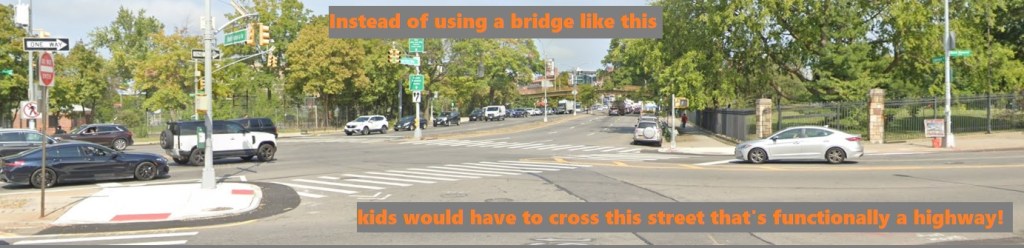
When Destination Greenways presented their plan, they excluded the bridge because it is quite steep, instead pushing everyone to compete with cars on College Point Boulevard, one of the most dangerous streets in Queens.

We suggest replacing this bridge with an ADA-compliant bridge and ramps, ensuring accessibility for all. If designed with the needs of the Botanical Gardens in mind, it could create event spaces underneath the bridge and ramps, from amphitheaters to other facilities, not to mention an additional entrance. A sufficiently long bridge would offer a unique travel experience through the canopy of magnificent trees, turning it into an educational destination.
A greenway plan that integrates an ADA-compliant bridge and ramps would eliminate the need for greenway users to navigate across six lanes of traffic adjacent to an expressway on-ramp, forging a vital link between Corona/Jackson Heights and the Botanical Gardens, Flushing, and the Eastern Queens Greenway. This would turn the most dangerous part of the greenway into the most enjoyable.
Motor Parkway East
Creating two spurs from the Motor Parkway would significantly improve access to the Eastern Queens Greenway.
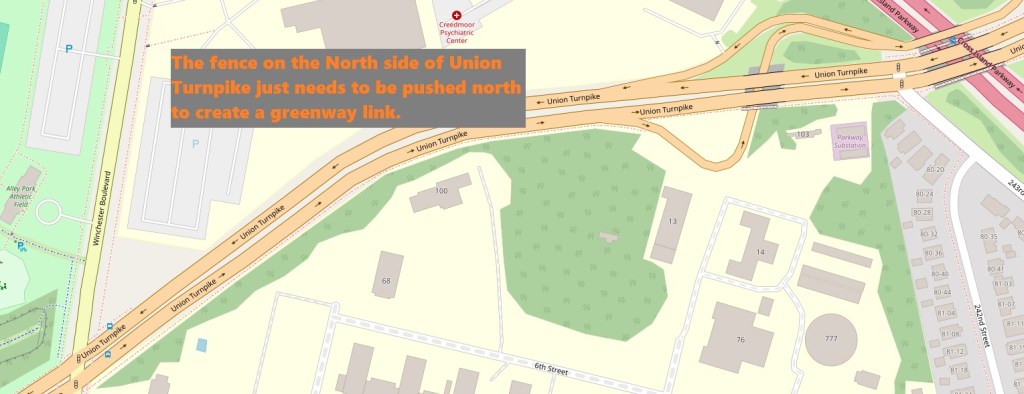
A brief trail along Union Turnpike, from Winchester Boulevard to Commonwealth Boulevard, would make it safer and easier for students to get to and from the Padavan Campus and provide safer connectivity between Glen Oaks and the greenway network. This would require collaboration with the governor’s office and the relocation of the Creedmore Fence.
A second southbound spur could be built as a bidirectional protected bike lane along the east side of Winchester Boulivard from Union Turnpike to 88th Avenue. This bike lane would not significantly affect parking availability and would greatly improve park access for the Queens Village and Bellerose communities.
Northern Boulevard
The complex interplay of traffic on Northern Boulevard demands careful reconfiguration. A 2019 study by Hunter Urban Policy and Planning proposed redesigning the intersection of Northern Blvd and the Cross Island Parkway to reduce conflicts between drivers and non-motorized users. We believe that the northbound off-ramp to westbound Northern Boulevard should be realigned to utilize the traffic light, facilitating smoother transitions for both east and westbound traffic. This change would also reclaim significant land for the Alley Pond Environmental Center and simplify maintenance demands. It would also allow for the elimination of a separate northbound off-ramp for eastbound travel, which currently creates conflicts with the greenway.
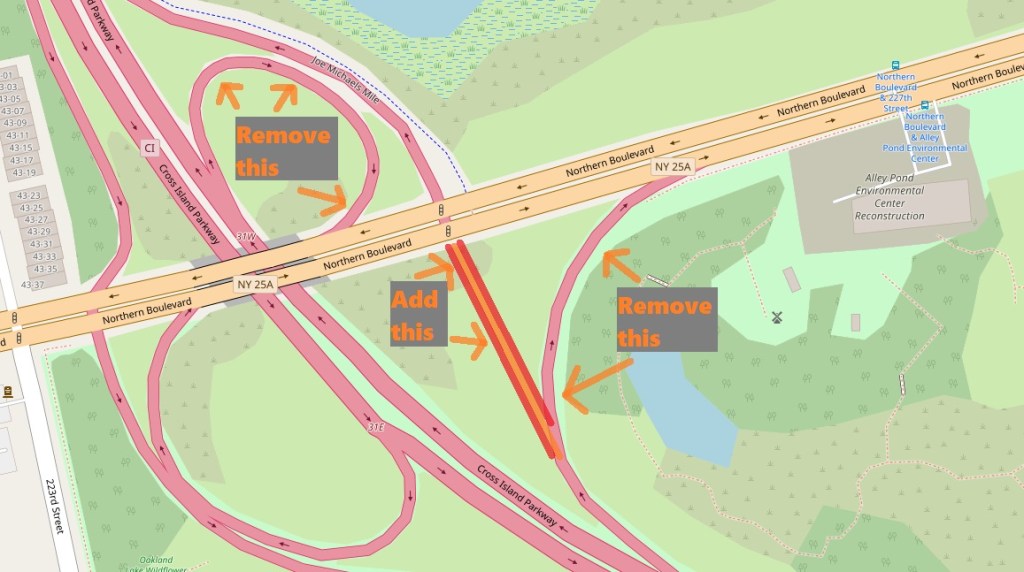
Additionally, the introduction of a concrete pedestrian island at 223rd Street and Northern Boulevard would physically protect pedestrians and cyclists.
Long Island Expressway
Destination Greenways envisions an improved connection at East Hampton Boulevard over the Long Island Expressway (LIE). The sidewalk widening project, a collaborative effort between the New York State and New York City Departments of Transportation (DoT), would enhance pedestrian accessibility.
Additionally, we suggest adding a concrete pedestrian island at 233rd Street and East Hampton Boulevard to ensure safer crossings.

Fort Totten
The final jewel in this proposal is Fort Totten. The city is considering improvements here as part of its Queens Waterfront Greenway initiative. We recommend establishing a better connection between the end of Joe Michaels’s Mile and the beginning of the Little Bay Greenway, as well as constructing a bridge over Totten Creek from Joe Michaels’s Mile to the south side of Fort Totten. This could lead to a greenway linking the island’s south and east sides to Shore Road.

The Urgent Need
In the grand tapestry of New York City’s urban planning, the proposed projects supported by these grants represent more than mere infrastructural improvements. They are a testament to a city striving for a harmonious blend of mobility, safety, and environmental stewardship. As we stand on the cusp of securing a second round of funding, the vision of a pedestrian and cyclist-friendly New York City edges ever closer to reality.
In a metropolis where every square inch is precious, these proposed enhancements could redefine how New Yorkers interact with their city, fostering a culture that values non-motorized travel and the serene pockets of green amid the urban sprawl. These grants are not just an investment in infrastructure—they are investments in the future, ensuring that New York City remains a beacon of innovation and sustainability for generations to come. This is our call to action; let’s secure grants for these projects and transform New York City into the pedestrian paradise it aspires to be.
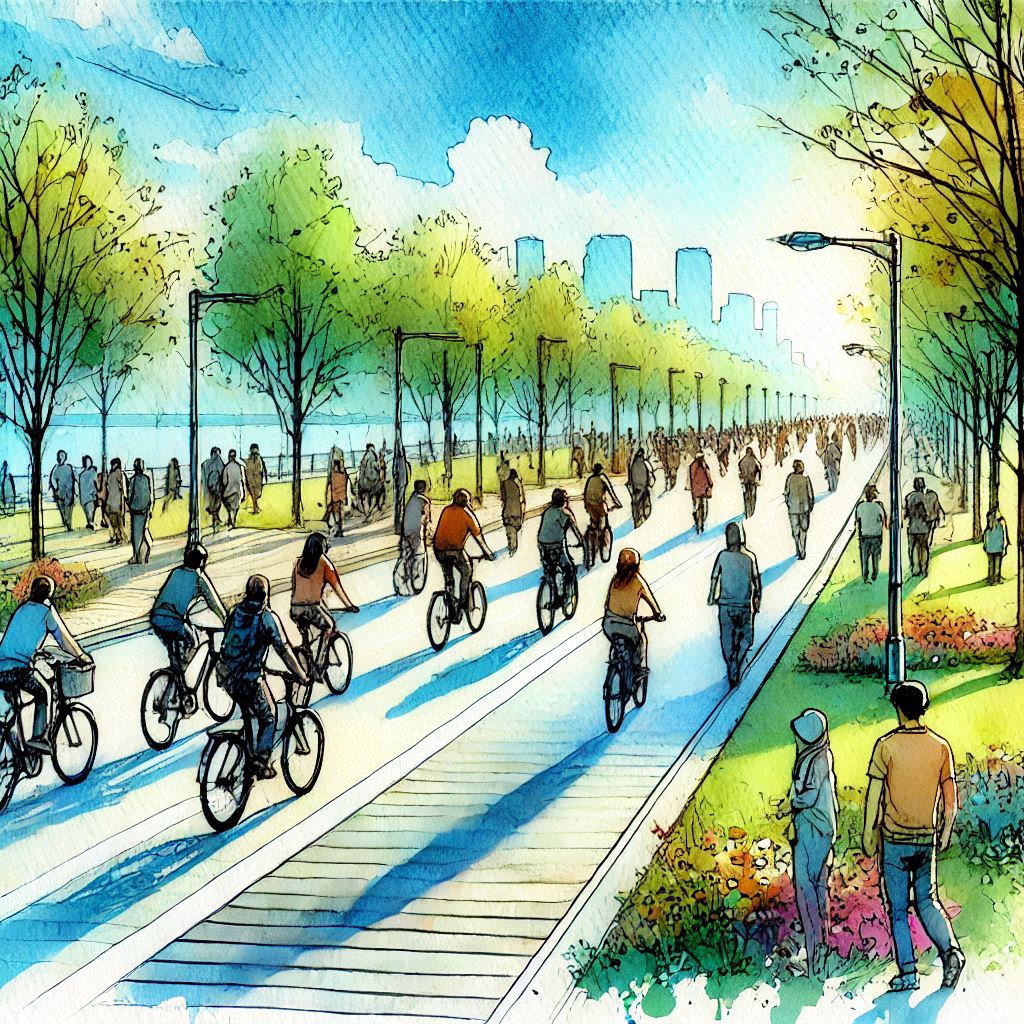
 Eastern Queens Greenway