To: New York City Department of Environmental Protection, NYC Parks & Recreation, New York State Department of Environmental Conservation, Queens Community Board 7, and Elected Officials Representing Eastern Queens
We, the undersigned organizations and community members, urge the City of New York to daylight the buried segment of Kissena Creek (also known as Ireland Mill Creek) from Kissena Lake westward to Kissena Boulevard. This will be a critical step toward reducing neighborhood flooding, curbing combined sewer overflows, and restoring a vital piece of Queens’ ecological heritage.
The History of a Buried Stream
Kissena Creek once flowed openly through the heart of Eastern Queens, fed by glacial wetlands and natural springs. Originating in a now-filled swamp in the Kew Gardens Hills and Pomonok neighborhoods, the creek traveled east to Hillcrest, then north through what is now Kissena Park, Kissena Corridor, and the Queens Botanical Garden, before merging with the Flushing River in Flushing Meadows–Corona Park.
Figure 1: Tallman Island WWTP Service Area – Combined Sewer Overflow Long Term Control Plan for Alley Creek and Little Neck Bay 2013 – Page 2-16

The creek began disappearing in the mid-twentieth century, effectively entombing it beneath the parkland it once nourished. Today, the trunk sewer mains running under Kissena Park handle stormwater from a massive drainage area measuring about 20% of Queens (according to NYC Environmental Protection’s Cloudburst Kissena Hub Community Meeting #1 on of 2024). This makes sense, since the main receives rainwater not only from the south along the original route of the creek, but also from as far east as Little Neck.
The Growing Problem: Chronic Flooding and Sewer Overload
Kissena Park suffers from both overland flooding (rain inundating the park’s low-lying fields during heavy rain) and system surcharging (enormous trunk sewer mains beneath the park becoming overloaded and forcing water back up through manholes and into streets and homes). Locally, we have seen the results of this untreated problem, with flooding leaving drivers stranded along busy highways, rainfall resulting in mass fish die-offs in Kissena Park, and, most tragically, when flood waters inundated and killed a family of three in their basement apartment on Peck Avenue.
We appreciate the beautifully designed stormwater upgrade that NYC DEP is piloting on the Cricket Field of Kissena Corridor Park. Daylighting Kissena Creek will supplement that project. As we can see from the DEP’s map, there is also substantial projected flooding both at the Cricket Fields and along the route of Kissena Creek. Both areas need attention and both areas will decrease the burden on the other.
Figure 2: Kissena Cloudburst Hub – NYC Environmental Protection

As former DEP Commissioner Rohit Aggarwala advocated, we need another body of water in Kissena Park. The larger Bluebelt project of daylighting Kissena Creek will be designed not only to hold floodwater, but also to connect our waterways to our park system. This enables our parkland to act as a sponge, absorbing and releasing excess water and naturally filtering it in the process.
Most importantly, daylighting Kissena Creek should decrease the Combined Sewer Overflow (CSO) that is poisoning Flushing Bay. We should be absorbing our rainwater where it lands, not mixing it with sewage and dumping it in Flushing Bay. Naturally managing the rainfall will decrease the use of a costly chlorination/dechlorination process. Kissena Creek will be a wide, open-air space designed to hold and evaporate much of the rainwater, entirely diverting it from the sewage system.
Why Now Is The Time To Act
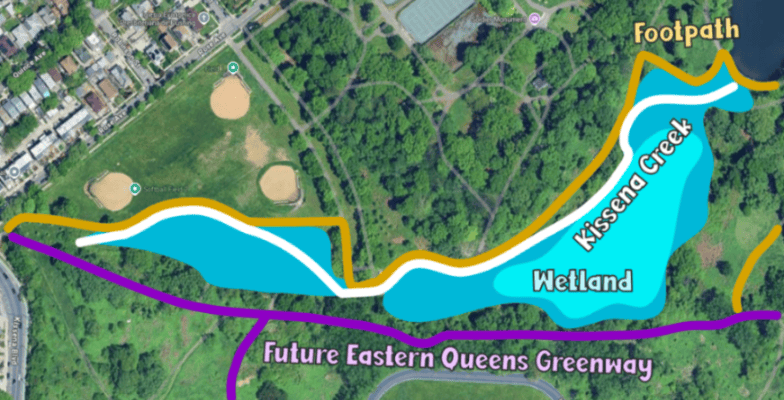
The Eastern Queens Greenway project is moving the current greenway path south onto higher ground (in part due to the constant flooding). By eliminating the former path, in addition to reconfiguring the softball fields, we are opening up a substantial amount of land along the historic Kissena Creek path. We estimate we can grow the wetlands from approximately 2.8 acres to a possible 8.75 acres of streams, natural pools, and new wetlands.
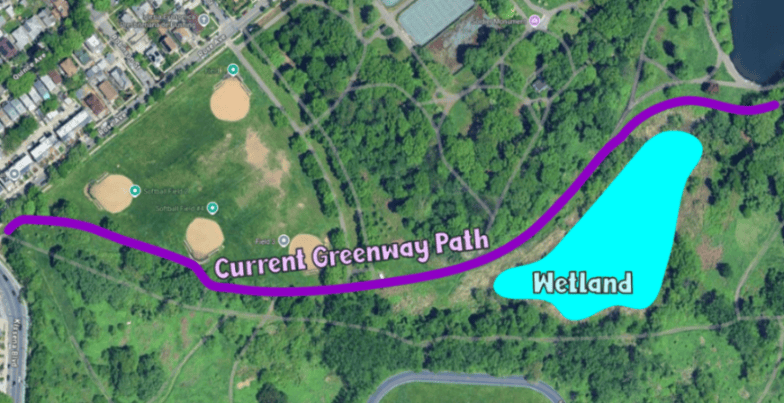
Figure 3: Current Kissena Park Layout – Kissena Creek Coalition
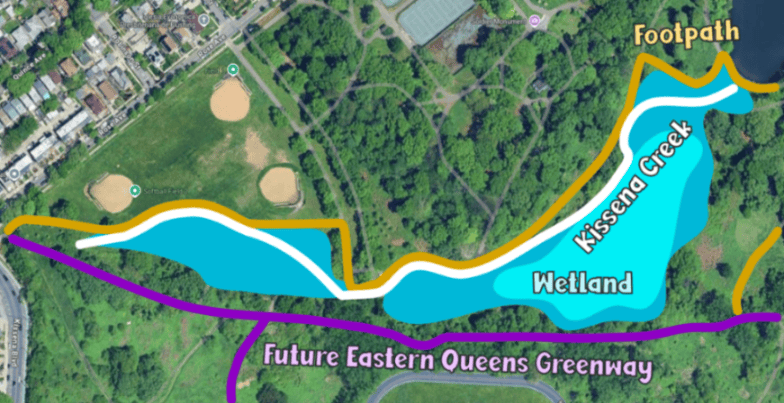
Figure 4: Possible Future Kissena Creek Path and Wetland Extension – Kissena Creek Coalition
The main goal of the Eastern Queens Greenway project is connecting diverse communities and giving park access to everyone. Although the planned greenway designed through Kissena Park creates a strong east/west path and connects to the south, it does not connect to the north of the park (despite our requests). Daylighting Kissena Creek has the potential to continue the barrier between neighbors north and south of the park. To decrease that disconnect, we are proposing a new footpath connecting the Eastern Queens Greenway to Kissena Lake, just east of the Kissena Creek proposal. A more efficient (though more expensive option) would be to create a small bridge over Kissena Creek at the velodrome spur. The Kissena Creek project should not only create more wetlands, but also better connect our communities.
The Cloudburst Cricket Field project will be a great improvement in the short term. As that is moving forward, we want to enhance it with plans for a longer-term Bluebelt solution that not only can absorb more water, but also can also filter, and evaporate it. The National Oceanic and Atmospheric Administration updated New York City’s climate classification from humid continental (Dfa) to humid subtropical (Cfa). As climate change continues to affect our neighborhood, we can only expect more severe storms. Well-planned wetlands can be our best defense against relentless weather.
In Yonkers the Saw Mill River Daylighting project uncovered approximately 1,100 linear feet of a river that had been confined in a concrete flume beneath downtown. The project included naturalized banks, pedestrian bridges, and green-infrastructure features while retaining the old underground channel as an overflow system to manage extreme storms. The daylighted river has significantly reduced flood risk, improved water quality, restored habitat, and created 13,775 square feet of aquatic habitat.
In the Bronx the Tibbetts Brook Daylighting Project represents an investment by NYC DEP and NYC Parks to restore a brook that has been buried for over a century. The project will remove clean stream water from the combined sewer system and reduce CSO discharges to the Harlem River by approximately 215 million gallons per year.
The construction of the new Eastern Queens Greenway, that enables Kissena Creek’s daylighting, is currently planned for 2030. By starting the Kissena Creek design now, we can not only influence the Greenway design, but also be ready to start the creek construction once the greenway is built. With this one project we can make a major impact in flood mitigation, CSO reduction, and ecological/community restoration. We appreciate the work that has been done so far. Now is the time we need to plan for the next step.
Our Request
We respectfully request that the New York City Department of Environmental Protection, in coordination with NYC Parks & Recreation:
- Commission a feasibility study for the daylighting of Kissena Creek from Kissena Lake to Kissena Boulevard, including hydrological modeling of Combined Sewer Overflow (CSO) and flood reduction benefits;
- Incorporate this project concept into the ongoing Flushing Bay Long-Term Control Plan modifications as a multi-benefit, green-infrastructure CSO reduction measure;
- Engage the community, through Community Board 7, local organizations, and the existing Kissena Cloudburst Hub outreach process, in a transparent planning and design dialogue.
Kissena Creek has been underground for eighty years. It is time to bring it back to the light, for the health of Flushing Bay, for the plants and animals in Kissena Park, and for the community it once sustained.
As Mayor Zohran Mamdani has said, “…the infrastructure of the city has shown itself unable to keep up with rainfall that dwarfs the amount that our sewage system was built for more than 100 years ago…The climate crisis is already here… the resilient infrastructure we need can no longer be denied.”
Signed,
Cody Herrmann
Watershed Advocacy Manager of Guardians of Flushing Bay
Leona Chin
Founder of Kissena Synergy

Furhana Husani
Vice President of Programs and Strategy for Waterfront Alliance
Mike Lieberman
Program Director of Trust for Public Land

Andrew Fisk, Ph.D.
Northeast Regional Director of American Rivers
Evie Hantzopoulos
Executive Director of Queens Botanical Garden
Jessica Burke
Founding President of Friends of Crocheron & John Golden Park
John (Johnny) Kelly III
President of Kissena Park Civic Association
Joby Jacob
Founder of Motor Parkway East
John Kelly
Co-Founder of Eastern Queens Greenway